Table of Contents
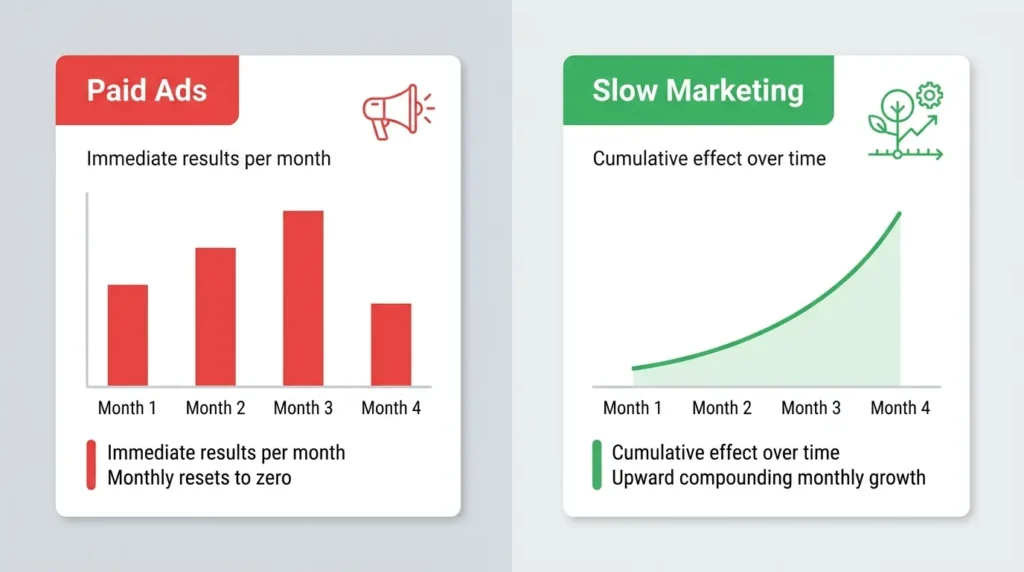
Most marketing advice is built around speed. Post daily. Run ads. Scale fast. The problem with all of it: the moment you stop, it stops. You are not building anything. You are renting attention on a rolling lease with no equity.
Slow marketing is the alternative. And for small or founder-led businesses, it is often the smarter bet.
Direct Answer: Slow marketing is a strategy built on compounding brand assets: content, authority, and trust developed over months and years rather than paid impressions bought week to week. It outperforms paid channels on a long enough timeline because it creates owned distribution that appreciates in value, not rented attention that expires the moment the budget does.
What Is Slow Marketing, and Why Is It Not Just Doing Less?
The phrase sounds passive. It is not.
Slow marketing is intentional. It is a deliberate choice to invest in assets that take longer to produce results but do not require continuous spending to maintain. A blog post that ranks for a keyword for three years. A YouTube video surfacing in search every week without ad spend. A newsletter with a 40% open rate built entirely from real opt-ins.
These are not slow because they are lazy. They are slow because they are building something the fast approach never can: compounding distribution.
The distinction matters. A founder running paid ads is buying traffic. A founder doing slow marketing is building a pipeline.
Why Does Slow Marketing Work Better for Small or Founder-Led Teams?
Paid marketing is a volume game. To win at it, you need either a large budget or a high-margin product that can absorb customer acquisition costs. Most early-stage small businesses or founders have neither.
Slow marketing flips the constraint. The scarcest resource for a lean team is not money. It is time and expertise. Slow marketing turns that expertise into assets: articles, frameworks, case studies, and practitioner opinions that work while you sleep.
What I have seen consistently, working with small businesses and founder-led teams: the businesses that built the strongest pipelines by year three did not outspend anyone. They out-published, out-taught, and out-positioned their competitors through content that built genuine authority.
Slow marketing is not a fallback for small businesses or founders who cannot afford ads. It is the primary growth engine that understands compounding.
What Does a Slow Marketing System Actually Look Like?
Slow marketing is not random content creation. It is a system. Here is how I structure it for lean teams:
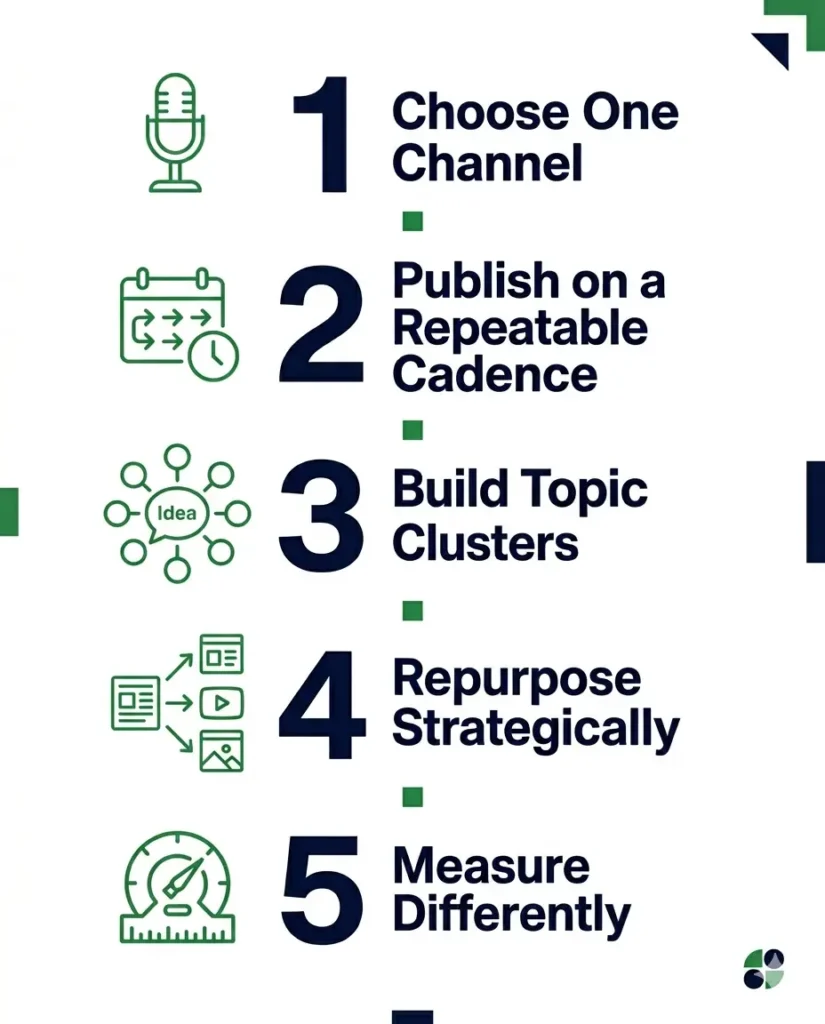
1. Choose one primary channel. Pick the channel where your audience already searches or consumes content: Google (SEO blog), YouTube, LinkedIn, or email. Do not spread thin. One channel done well beats five channels done poorly.
2. Publish on a repeatable cadence. Consistency beats frequency every time. One high-quality piece per week outperforms five mediocre posts. The algorithm rewards consistency. So does your audience.
3. Build topic clusters, not isolated posts. Every piece of content should belong to a cluster: a group of related articles that signal topical authority to search engines. A post on growth marketing links to posts on growth loops, GEO, and content strategy. They reinforce each other and collectively rank higher than any one post would alone.
4. Repurpose, do not just recycle. A blog post becomes a LinkedIn carousel. A newsletter issue becomes a short-form video script. The core idea moves across channels without starting from scratch every time.
5. Measure differently. Slow marketing metrics are not clicks and impressions this week. They are organic traffic trends over 90 days. Domain authority over six months. Email subscriber growth rate over a year. If you measure slow marketing with fast marketing metrics, you will quit before it works.
Slow Marketing: A brand-building approach that prioritizes the creation of compounding content assets over paid or short-term traffic generation. Rather than buying attention on a per-impression basis, slow marketing accumulates owned distribution through SEO content, thought leadership, and audience trust built consistently over time. It is designed for long-term ROI rather than immediate conversion.
The Insight Most Marketing Blogs Skip: Slow Marketing Is a Balance Sheet Play
Here is the angle you will not find in a generic marketing roundup.
Fast marketing is a P&L expense. Slow marketing is a balance sheet asset.
When you spend on ads, that money is gone. It produced results during the period you ran it, and those results disappear when the spending stops. It shows up as an operating expense: consumed, expired, zero residual value.
When you publish a blog post that ranks for a target keyword, that post holds ongoing value. It generates traffic, leads, and brand visibility on a recurring basis with no additional spend. If you sold your business tomorrow, that content library would factor into the valuation. It is an intangible asset, not a line-item cost.
This is not a metaphor. It is how I frame slow marketing to every small business and founder I work with: you are building equity, not just running campaigns.
I have worked with small and founder-led businesses, generating thousands of monthly visitors from content published 18 months prior. That content still performs. The paid campaign from the same period? Gone without a trace.
I am a growth marketing consultant, frame slow marketing as an asset-building strategy rather than a channel strategy, and that reframe changes how founders and small businesses prioritise it in the early stages when capital is limited and every decision needs to compound.
Is Slow Marketing Too Slow? Here’s the Real Timeline
The honest answer: yes, it is slow. And that is the point.
Most SEO content takes three to six months to rank meaningfully. A newsletter takes six to twelve months to build compounding momentum. A LinkedIn presence with genuine reach takes consistent publishing over one to two years.
None of that is broken. That is what compounding looks like before the curve bends.
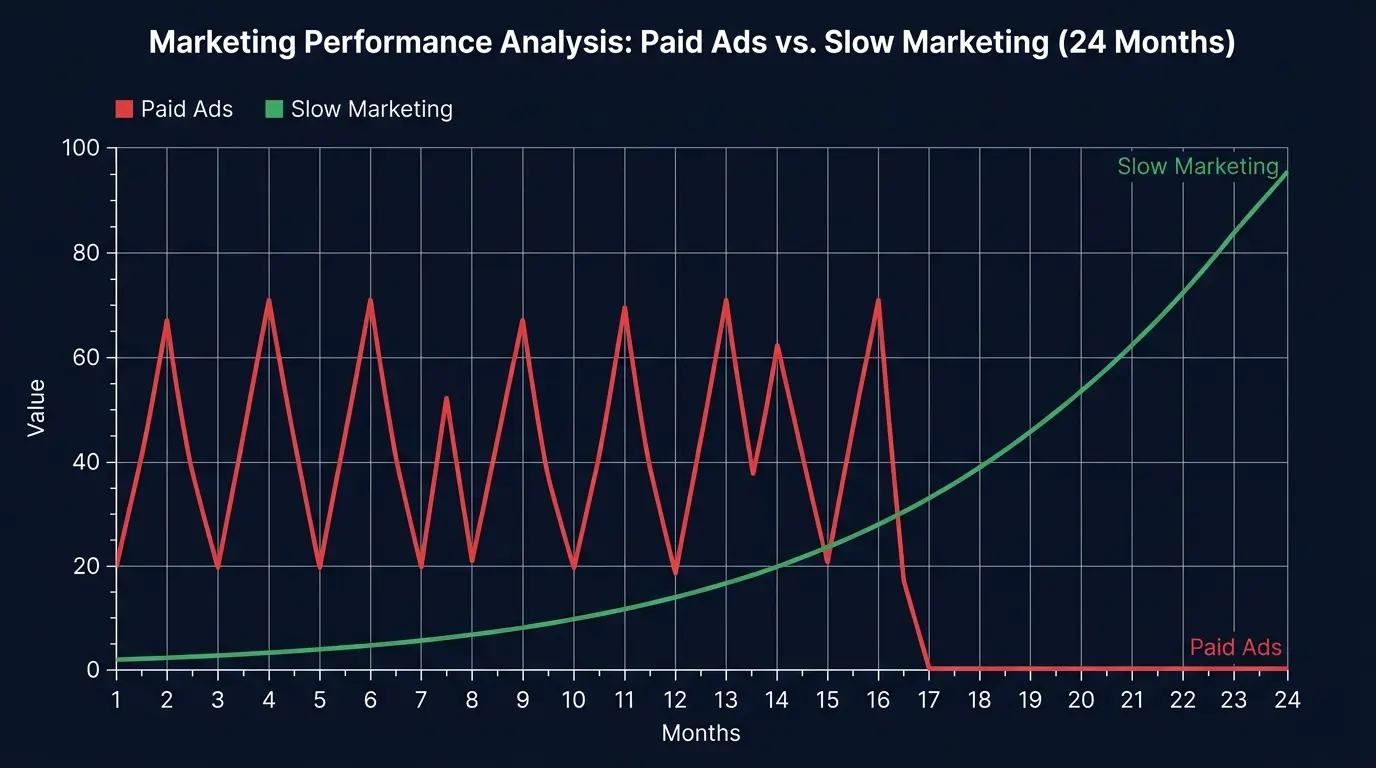
Businesses that quit slow marketing do so at month three or four, right before the inflection point. They switch back to paid ads, reset the clock, and wonder why they never built organic reach.
Here is a practical way to hold the timeline in your head. Slow marketing has a high upfront cost in time and a low ongoing cost in money. Paid marketing has a low upfront cost in time and a high ongoing cost in money. At some point, those two curves cross. After that crossing point, slow marketing wins on every metric that matters: cost per lead, customer trust, and brand durability.
The question is not whether slow marketing works. The question is whether you can outlast the ramp.
FAQ: Slow Marketing
What is slow marketing?
Slow marketing is a long-game brand-building strategy focused on creating content assets that generate organic traffic, authority, and audience trust over time. It prioritizes owned distribution over paid channels and compounds in value rather than expiring when spending stops.
How long does slow marketing take to produce results?
SEO blog content typically ranks meaningfully three to six months after publication. Newsletter and social audience building show clear compounding momentum after six to twelve months of consistent publishing. The timeline feels long at the start and irreversible once the curve bends.
Is slow marketing only for businesses without a budget?
No. Slow marketing is for any business that wants durable, compounding growth. Many businesses with strong paid media budgets also invest in slow marketing to reduce channel dependence and build long-term brand equity alongside short-term performance campaigns.
Can I run slow marketing and paid ads at the same time?
Yes, and this is often the strongest approach. Use paid media to generate short-term leads and revenue while slow marketing builds organic reach in parallel. As slow marketing matures, you can reduce paid spend without losing pipeline.
What content formats work best for slow marketing?
SEO blog posts targeting informational and commercial keywords, email newsletters, long-form LinkedIn content, and YouTube videos built around search intent all perform well. The best format is the one that matches where your audience already spends time and searches for answers.